

Overview/Background
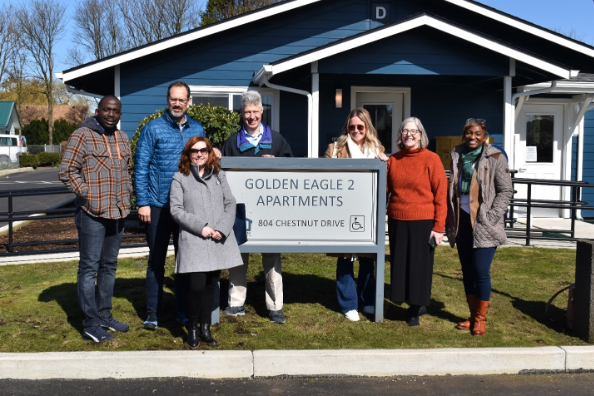
The affordable housing crisis across the U.S. is particularly acute in rural communities where the loss of even a few units can disproportionately affect vulnerable residents. Tillamook, Oregon, exemplified this challenge when the owners of Golden Eagle II, a 33-unit U.S. Department of Agriculture Section 515 property, announced plans to sell in 2016. USDA Section 515 properties are those classified as providing housing for very low- to moderate-income, elderly, and disabled residents. The sale would have removed affordability protections, jeopardizing housing for low-income seniors and families, many of whom relied on Social Security and had an average annual income of just $15,257.
The situation mirrored the recent sale of neighboring Golden Eagle I, where residents were displaced after the new owner prepaid the USDA 515 loan, which cancelled the rental assistance. A 2019 Tillamook County Housing Needs Analysis revealed a shortage of 600+ affordable units for the lowest-income residents, intensifying the urgency to preserve Golden Eagle II.
Process/Steps Taken
To guarantee the financing of the Golden Eagle II Housing Development, keep the building owned locally, preserve housing for the residents, and ensure the development’s sustainability, the following process was enacted:
- Advocacy & Acquisition (2016–2021): Legal advocates halted the sale, allowing local nonprofit Northwest Coastal Housing (NCH) to step in as buyer.
- Financing Secured (2022): HAC and RCAC partnered to provide the $7.8M construction loan, enabling NCH (a first-time LIHTC user) to proceed.
- Rehabilitation (18 months):
- Roof replacements
- Kitchen and exterior upgrades
- Improved walkways
- Minimized resident displacement by keeping vacant units available
- Completion (2023): Golden Eagle II was preserved as affordable housing with modernized amenities.
Project Details – Capital/Partnership Stack
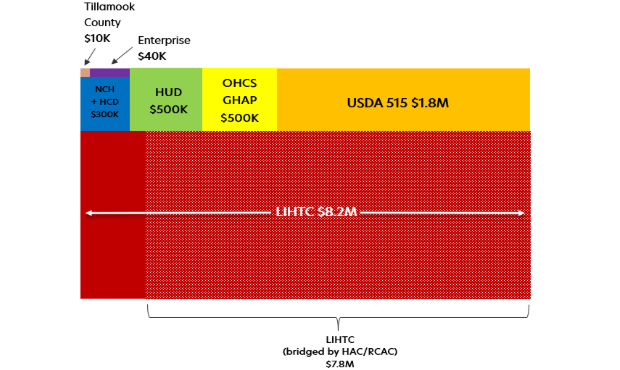
Partners for Rural Transformation (PRT)’s National Partner Housing Assistance Council (HAC), and Steering Committee Partner CDFI Rural Community Assistance Corporation (RCAC) jointly contributed to the following innovative capital stack that local, state, and national stakeholders pulled together to save Golden Eagle II via the following methodology:
- Local Nonprofits: Northwest Coastal Housing (NCH) & The Housing Development Center (HDC) – $1.9M
- NCH purchased the property in Dec. 2021 for $1.9 million, using USDA financing to maintain rental assistance, and HDC assisted them with the application.
- Funding Sources:
- Low-Income Housing Tax Credits (LIHTC) Equity – $8.2M
- USDA 515 – $1.8M
- Oregon Housing and Community Services General Housing Account Program (OHCS-GHAP) – $500K
- HUD Economic Development Initiative, Community Project Funding grant, facilitated by Senator Jeff Merkley (D-OR) – $500K
- $7.8 million construction loan from:
- Housing Assistance Council (HAC) – A national PRT Partner CDFI provided part of the loan.
- Rural Community Assistance Corporation (RCAC) – A PRT-member CDFI purchased a 50% participation interest to share risk.
This public-private partnership ensured the property’s rehabilitation while keeping tenants housed.
Outcomes & Impact
With the process and capital stack complete, the following outcomes were achieved:
- 33 units preserved for low-income seniors and families.
- Rental assistance continued for vulnerable residents.
- Improved living conditions with critical upgrades.
- No displacement—residents remained onsite during construction.
- Model for rural preservation: Demonstrated how CDFIs, nonprofits, and legal advocates can collaborate to protect affordable housing.